


Total Solar Eclipse on April 8, 2024
Witnessing the Celestial Spectacle
By Hostal Mexiquillo
Published on
Category

Witnessing the Celestial Spectacle: Durango is the epicenter and the best place to experience the Total Solar Eclipse on April 8, 2024
The 2024 total solar eclipse is getting closer, and the best destinations to see the splendor of the event are found in Mexico.
On April 8, 2024, the skies of North America will light up with an impressive celestial phenomenon: a total solar eclipse. This astronomical event will capture the attention of observers in different parts of the continent, offering a unique experience for those who have the opportunity to witness it.
This cosmic spectacle will adorn the skies with a total solar eclipse, where the Moon completely obscures the Sun, casting a shadow over the entire North American continent: Mexico, the United States, and Canada. Although the eclipse will be visible along a specific trajectory, Durango, Mexico, stands out as the perfect place to experience this celestial event.
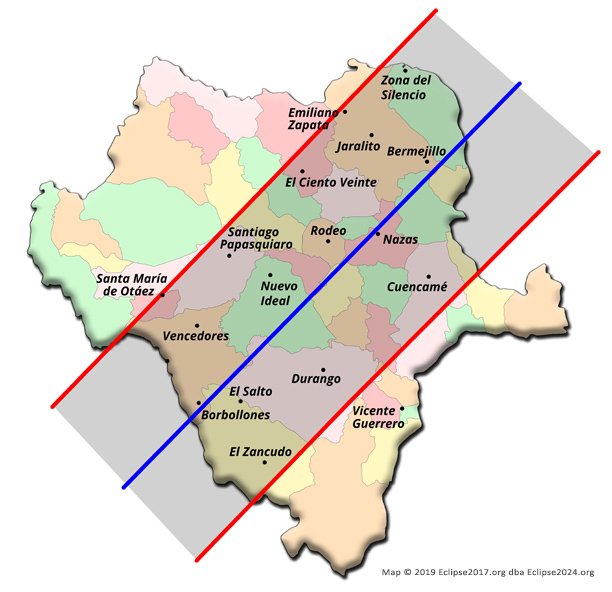
Durango is strategically positioned in the path of totality for the solar eclipse of April 8, 2024. This means it is among the privileged places on Earth where day will transform into night for a surprising 4 minutes and 28 seconds in the municipality of Nazas, Durango. The alignment of the Sun, the Moon, and the Earth is a celestial ballet that presents a once-in-a-lifetime opportunity, and Durango is in the front row.
To witness this incredible total solar eclipse, you must be within the path
of totality, which is 115 miles wide.
This unique and extraordinary event will be visible from our observation sites in Mexiquillo and Canatlán for approximately 4 minutes and 27 seconds, and the best part is that you will enjoy the entire experience with experts narrating and broadcasting the phenomenon, in addition to the comforts of comfortable lodging, delicious country-style food, activities such as hiking, rappelling, stargazing, and bohemian night, among many other surprises.
According to astronomical calculations, in Durango, the eclipse will begin at 11:00 in the morning. The total phase of the eclipse will start at 11:07:25 am and end at 1:00 pm. Its maximum point will be at 12:08 pm. The city of Nazas, Durango, is located almost exactly on the center line, and is the closest place to the point of greatest eclipse! This means people will see 4m 28s of totality, the longest possible for this eclipse, just before 12:15 MDT. This duration is the longest on the entire continent. Counting the partial and total stages, the duration of the eclipse will be 2 hours and 41 minutes.
Other cities in Mexico where the total eclipse can be seen include Mazatlán, Torreón, and Monclova, although with a shorter duration. However, most of the country will experience the partial eclipse. For example, during the maximum phase of the eclipse in Mexico City, the Moon will cover 79% of the solar disk.
Visibility times in different municipalities of Durango.
| Nazas | 4 minutes 28 seconds |
| Pueblo Nuevo (Mexiquillo) | 4 minutes 27 seconds |
| Canatlán | 4 minutes 27 seconds |
| San Juan del Rio | 4 minutes 25 seconds |
| Mapimí | 4 minutes 23 seconds |
| Tlahualilo | 4 minutes 23 seconds |
| Rodeo | 4 minutes 20 seconds |
| Lerdo | 4 minutes 17 seconds |
| Gómez Palacio | 4 minutos 17 segundos |
| Nuevo Ideal | 4 minutes 02 seconds |
| Durango | 3 minutes 46 seconds |
What is a solar eclipse and what does it look like?
When we have an eclipse of this type, the body that interposes itself is the Moon, as it positions itself between the Sun and the Earth. Thus, a total or partial blockage of sunlight is produced. Its main manifestation is the projection of a shadow on the Earth’s surface.
Eclipses are one of nature’s most spectacular phenomena. They occur when the Sun, the Moon, and the Earth are placed along a straight line. If the Earth is in the middle of the other two celestial bodies, we have a lunar eclipse. If the Moon is in the middle of the Sun and the Earth, then we speak of a solar eclipse.
Although between two and five solar eclipses can occur per year, most are partial. The last time we observed a total solar eclipse in Mexico was on July 11, 1991, and the next one will occur until March 30, 2052.
Safety and Tips for Observation.
Except during the brief total phase of a total solar eclipse, when the Moon completely blocks the bright face of the Sun, it is not safe to look directly at the Sun without specialized eye protection for solar observation.
Viewing any part of the bright Sun through a camera lens, binoculars, or a telescope without a special solar filter secured on the front of the optics will instantly cause serious eye injuries.
When observing the partial phases of the solar eclipse directly with your eyes, which occur before and after totality, you must look through safe solar glasses (“eclipse glasses”) or a safe portable solar viewer at all times. Eclipse glasses are NOT regular sunglasses; Regular sunglasses, no matter how dark, are not safe for viewing the sun. Safe solar viewers are thousands of times darker and should comply with the international standard ISO 12312-2.
Always inspect your eclipse glasses or portable viewer before using them; If it is torn, scratched, or otherwise damaged, discard the device. Always supervise children using solar viewers.
DO NOT look at the Sun through a camera lens, telescope, binoculars, or any other optical device while using eclipse glasses or a portable solar viewer; concentrated solar rays will burn the filter and cause serious eye injuries.
DO NOT use eclipse glasses or portable viewers with cameras, binoculars, or telescopes. These require different types of solar filters. When observing the partial phases of the eclipse through cameras, binoculars, or telescopes equipped with appropriate solar filters, it is not necessary to use eclipse glasses. (Solar filters do the same job as eclipse glasses to protect your eyes).
Here are some important safety guidelines to follow during a total solar eclipse.
View the Sun through eclipse glasses or a portable solar viewer during the partial eclipse phases before and after totality.
You can view the eclipse directly without proper eye protection only when the Moon completely obscures the bright face of the Sun, during the brief and spectacular period known as totality. (You will know it is safe when you can no longer see any part of the Sun through eclipse glasses or a solar viewer).
As soon as you see even a small part of the bright Sun reappear after its totality, immediately put your eclipse glasses back on or use a portable solar viewer to look at the Sun.
Skin Safety.
Even during a partial or annular eclipse, or during the partial phases of a total eclipse, the Sun will be very bright. If you are watching a complete eclipse, it is possible that you will be exposed to direct sunlight for hours. Remember to use sunscreen, a hat, and protective clothing to prevent skin damage.
CONCLUSION
The total solar eclipse of April 8, 2024, will be a unique opportunity to connect with the cosmos and marvel at the beauty of the solar system. Durango, Mexico, is a celestial gift for eclipse enthusiasts and for everyone who wants to live this experience in its totality.
Its geographical position, impressive natural landscapes, an incredible sky, warm hospitality, and authentic traditional cuisine, make it the perfect place to witness the solar eclipse. So, mark your calendars and get ready to be part of a phenomenon that will leave unique memories in your life.
It is an opportunity to reconnect with nature, culture, and the cosmos in a place where day will turn into night and the universe reveals its celestial wonders. Don’t miss this extraordinary event in the heart of Mexico.
Durango is waiting to welcome you for an experience that will not be witnessed again until 2053.
Plan ahead, follow safety measures, and get ready to witness an unforgettable celestial spectacle.